




 Locations







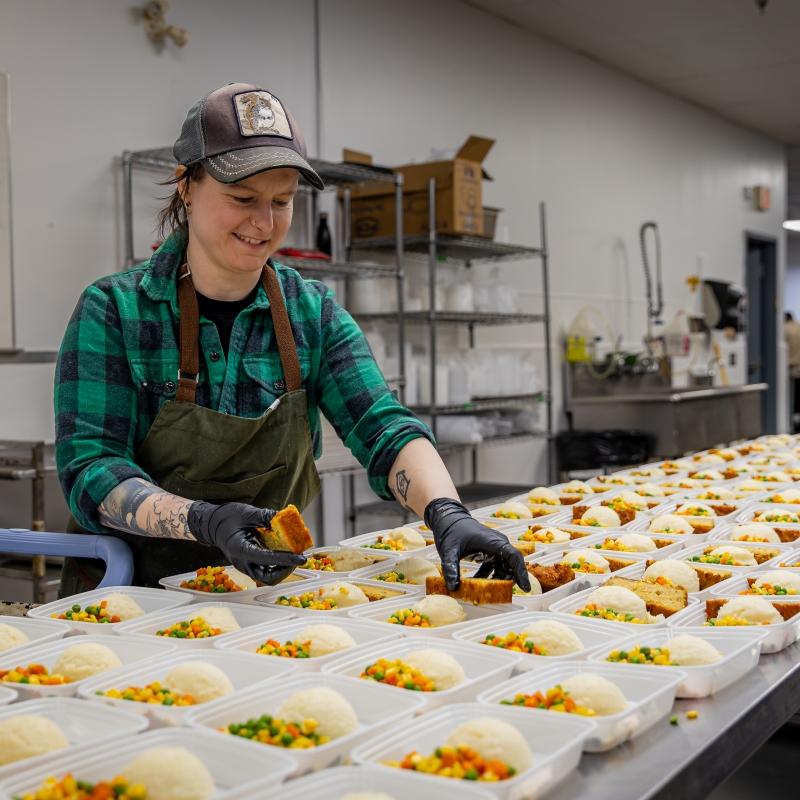
Every morning in our kitchens from Vancouver to Halifax, before the first tray goes into the oven, one number sits in my head, and it is $7.
That is roughly what it costs in 2026 to make a full, chef-made, impact focused, meal the right way, with real protein, real vegetables and cooks paid a wage they can live on.
Before delivery, before operational costs, just food, labour and packaging.
After 15 years and more than seven million meals from kitchens on both coasts, I have learned that if you pull that seven dollars apart line by line, you end up holding a map of every weak joint in Canada's food system.
Breaking down the cost
Take a braised beef shepherd’s pie, the kind of meal we send into schools, campuses and shelters, then follow the money.
Protein hurts the most, at about $1.90 a plate. After nearly a decade of drought, Canada's cattle herd is the smallest it has been since the late 1980s, so retail beef ran 27 per cent higher year over year in November 2025 and was still up 8.7 per cent this September, even while overall grocery inflation cooled to 1.7 per cent.
On a program of 4,000 meals a week, a ten-cent move in protein costs $400 a week, more than $20,000 a year; money no meal program funder has sitting in a drawer.
Produce, grains and dairy add about $1.20. Vegetables jumped 7.8 per cent year-over-year in April, while Statistics Canada now puts grocery prices 33 per cent above where they sat in September 2020. That is why we build our menus around barley, pulses, root vegetables and what we grow at Upward Farm in Dartmouth, because those hold their price far better than lettuce trucked up from California.
Packaging can run about 55 cents, which surprises people until they realize the container, lid and label cost nearly a third of what the meat does.
Impact of tariffs
Since Sept. 8, Canada's counter-tariffs of 15, 25 or 50 per cent on $27.6 billion of American goods have reached into plastics, pulp and paper, the materials behind much of the food-service packaging we buy from south of the border. A few cents on a clamshell means nothing to a restaurant charging $22 a bowl, but in a school program it can decide whether fruit makes the tray.
Freight adds about 45 cents, moving with every spike at the pump. Gasoline was up 27.8 per cent year-over-year in September and fuel oil 57.8 per cent, hitting Atlantic Canada hardest, while 86 per cent of operators in a Restaurants Canada survey this summer said their suppliers had added fuel surcharges.
Labour is our largest line at about $2.10, and it is the one I will defend the hardest. Nova Scotia's minimum wage reached $17 an hour on October 1, up from $12.95 in April 2021 across eight increases. We pay above it on purpose, because our kitchens exist to employ people facing barriers to work; people who deserve a wage they can build a life on.
What this means for students
Rent, energy, insurance and food safety take another 55 cents, leaving about 25 cents of margin on a good day. Those 25 cents absorb every beef spike, tariff and fuel surcharge, sometimes all in one month. When we moved our campus frozen meal from $5 to $6 this fall, I could account for every cent of that dollar.
Here is what those 25 cents have already built. From a building we own in the Halifax Regional Municipality (HRM), our East kitchen will put more than a million meals into the HRM this year, cooked by people many employers had already written off. During the school year we feed 30 schools with the Halifax Regional Centre for Education, buying every ingredient from halal suppliers so every kid at the table can eat what is in front of them.
When school lets out, we send more than 10,000 summer meals to young people who would otherwise go without. This fall our frozen meals start going into Nova Scotia Community College (NSCC) and Saint Mary's University (SMU) campuses at 4,000 a week.
Anyone who has worked a school lunch line knows what one reliable meal does by 11 a.m., when a kid who came in hungry can finally sit still long enough to learn something. Anyone who has run a kitchen like ours knows what a steady paycheque does for a cook who walked in with an empty resume. Both of those things hang on those 25 cents, so a ten-cent swing in beef is never just a spreadsheet line for us.
Role of supply chains
With the National School Food Program now law and federal funding doubled to $140 million a year, this model can grow across the country, if the people upstream of our kitchens build for it. A processor holding a price from September to June, a plant making institutional containers on this side of the border or a distributor consolidating drops to public meal sites would each put cents back on every tray, cents that become fruit for the kids and wages for the cooks.
After 15 years and seven million meals in, I know this math works when everyone at the table puts something in and a core mandate of ours is people support what they co-create. So, our kitchen door and our cost sheet are open to any manufacturer, processor or distributor who wants to help us improve it.




 Industry Events
 Locations

