




 Locations






Canada’s food-tech sector has no shortage of support for early-stage innovation, but access to growth capital remains a significant barrier for companies looking to scale, according to investors and industry leaders who spoke at the recent Food Forward Summit.
One investor panellist, who arrived in Canada six years ago, said he was impressed by the initial level of support that government-funded organizations provide.
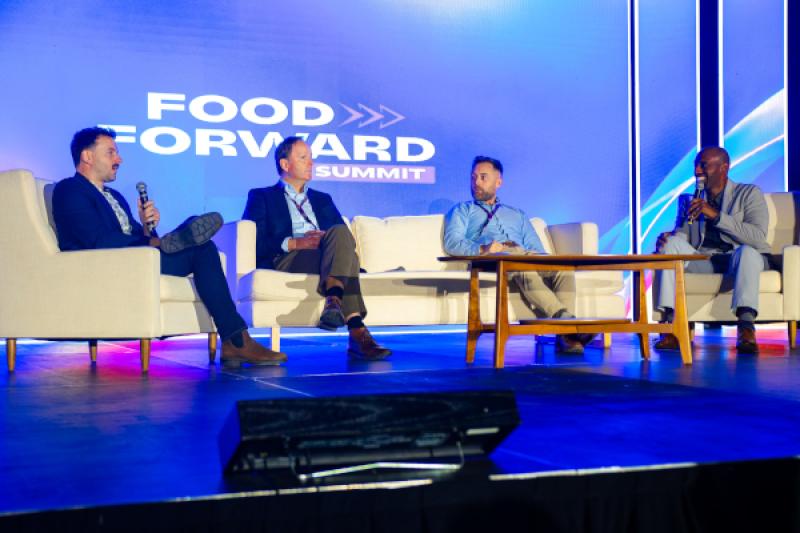
“You’ve got some great organizations that really support research and commercialization. You’ve got the likes of Natural Products Canada, the Canadian Food Innovation Network. You’ve got an ecosystem that can support each individual part of that that capital-stack journey,” John Cassidy, Canada managing director at Los Gatos, Calif.-based SVG Ventures-THRIVE, said during the discussion, Building Canada's Innovation Capital Stack: From Lab to Market to Global Scale at the summit in Mississauga, Ont.
“I think where we lack is probably on that growth-capital stage when companies are looking to grow beyond that to Series A and beyond,” Cassidy said.
Signs of improvement in growth funding
Another panellist, who is a founder of an ag-tech firm, agreed with Cassidy’s characterization but said things are slowly changing for the better.
“In the past five years, we’ve seen more support from the private sector through venture capital funds all the way toward Series A stage. On the government level, you’re starting to see better support as well, where it’s less focused on producing the IP (intellectual property) at a research level, to more at a fundamental level,” Marc-André Roberge, co-founder and chief executive officer of Montreal-based Nectar Technologies, said.
Nectar bills itself as the “digital operating system for better beekeeping,” on its website.
But governments and private investors are not solely responsible for the current environment, founders should also be ready to take the next step, he said.
New firms need to be “making sure that you actually come out not just with a technology but with a product that is usable, and that you’re going to be able to commercialize your technology, and make sure that ultimately you’re creating value for the country.”
Another investor said that the global funding landscape for food technology businesses has shifted over the past number of years after an initial boom.
“There was almost a FOMO (fear of missing out) into agri-food tech when you were attracting generalist capital; new investors, generalist funds into the space, and then suddenly that sort of bubble was burst,” Alastair Cooper, head of venture with Cibus Capital of London said.
There was eventually a “massive correction” shortly after the onset of the COVID-19 pandemic, he said.
“Capital flows are down probably 70 per cent into the space from where they were in 2021. Capital availability now is about the same as it was 10 years ago in 2016, 2017, and valuations in agri-food tech globally are probably down 70 per cent as well.”
“Probably 20 per cent of companies have gone bust in the space,” Cooper said.
But the current perspective looks promising, according to Cooper.
“As an investor, I think the next three or four years are a time of enormous opportunities. I think people will look back at this time and think this is a fabulous time, cyclically over the long term, to invest in this space because the tailwinds are only accelerating, whether it’s demographics or it’s climate change.”
“And then technology is progressing, obviously now accelerated by AI. Yet valuations are so low.”
How Canada can unlock growth capital
What steps can Canada take to capitalize on these opportunities?
Panel moderator Cordell Hardy, research and development vice-president food North America at U.S. farming giant Cargill, asked the participants: “What do we need here to help bridge the gap in driving more companies to be able to have success beyond at scaling in Canada and even at the global level?”
For Cassidy, the business is still evolving, so it’s hard to point to a single strategy.
“Ag-tech is still is an emerging space. We’re still trying to figure it out. I would say a lot of the non-diluted funding that came into the sector from 2018 to 2021: a lot of companies were funded that probably should not have been, and we’re starting to see some of the drop off now,” he said.
“But I think what we’re seeing right now, rather than saying there’s a disaster drop off in the industry, I would see it more so as a quality filter.”
And governments can do even more, according to Cooper, pointing to two prominent countries as examples.
“There’s varying degrees of support tax-wise for investors (in Canada). In the U.K., investors in venture get a 30 to 50 per cent tax kicker at the point of investment across the board. In the U.S., if you invest in venture for five years, you’re exempt from capital gains tax at that point.”
“Those type of things really help and attract capital into the space.”




 Industry Events
 Locations

