Locations







GoodLeaf Farms has become the first vertical farming operator in North America to achieve profitability across all of its farming operations, marking a significant milestone for the Guelph, Ont.-based company.
“Our sales have grown from $6.4 million in 2023 to $34 million last year, and we’re already up another 31 per cent this year,” Andy O’Brien, president and chief executive officer of GoodLeaf Farms, said to FoodNX in an email interview.
The company’s most recent financial results showed that what the company has been doing is working.
GoodLeaf was started in 2011 in Halifax with what O’Brien said is a “simple idea.”
“That we should be able to grow fresh, local leafy greens here in Canada year-round, even with our challenging climate.”
Wide range of microgreens
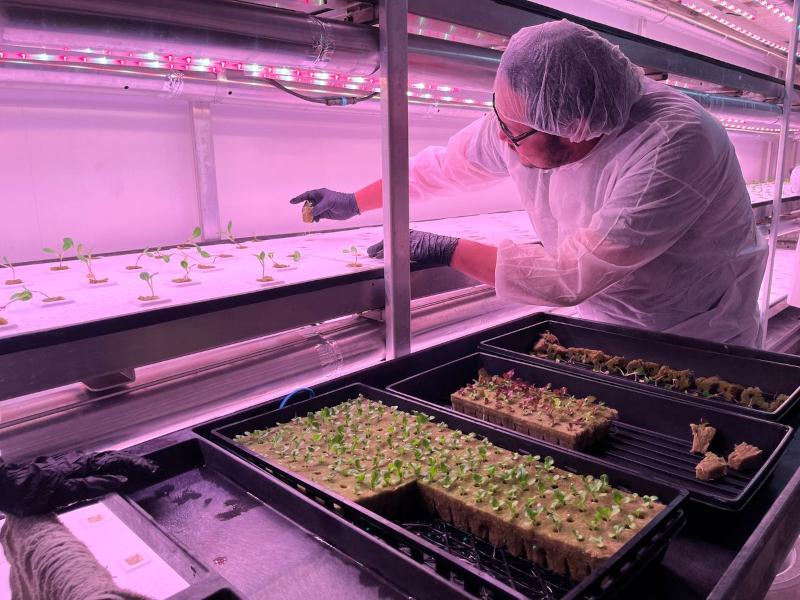
Today, the company produces “fresh, pesticide-free, nutrient-dense, baby greens, salad mixes and microgreens,” he explained.
Its plant lineup includes arugula, mustard, pea shoots, broccoli, radish and lettuce. The packages are sold in all major Canadian grocery stores, according to its website.
For O’Brien, the positive financial news is validating for a company that began without a lot of other entrants. “Reaching operational profitability is a big milestone for us because it shows that vertical farming can be both sustainable and financially viable,” he said.
Last year, the company raised $52 million in equity financing to expand its operations, as well as establish a new research and development centre in Ontario, according to a release. Investors include Farm Credit Canada (FCC), Power Sustainable Lios and McCain Foods
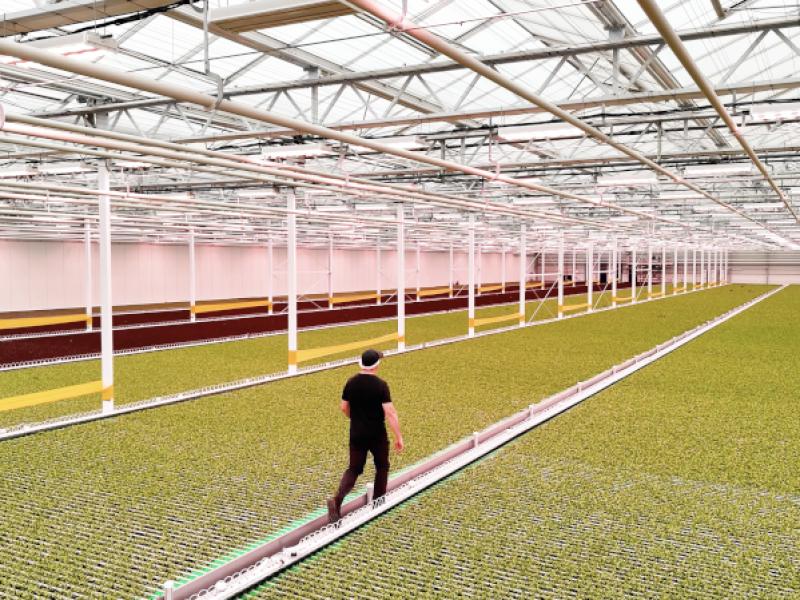
GoodLeaf is the largest Canadian vertical farming operation and it has three farms in Alberta, Ontario and Quebec.
So what exactly is vertical farming?
“Vertical farming consists of various methods to produce crops in a controlled environment in vertically stacked layers. High-density production of produce grown under optimum conditions for year-round, continued production utilizing minimal land base and soilless growing methods,” according to FCC.
GoodLeaf chose the microgreens in a vertical farming format because they are a “very good fit” for this type of growing operation, O’Brien explained.
“Because our greens can be harvested early in the growing cycle, we can produce a crop in anywhere from seven to 21 days. That short growing cycle allows us to make very efficient use of our growing space and produce more crops throughout the year.”
Consistency, sustainability keys to success
Such dependable operations are achieved due to the quick growing seasons and the fact that light, temperature, watering and humidity levels are all strictly controlled in GoodLeaf's facilities.
“Microgreens grow quickly, they’re nutrient-dense, they have incredible flavour, and vertical farming allows us to grow them consistently and efficiently, regardless of what’s happening outside,” O’Brien said.
The “big nutritional punch” offered by these products is another plus for health-conscious consumers.
“Some have up to 166 times more nutrients than their mature counterparts and that’s also why they have a really intense, fresh flavour that makes them so delicious.”
GoodLeaf’s operations are also environmentally friendly, according to O’Brien.
“For example, we collect, filter and reuse about 95 per cent of our water. We also compost our growing substrate and any non-edible plant material, and we use energy-efficient LED lighting.”
Maintaining momentum in the face of tariffs
Despite current challenges, including tariffs being felt across many of the supply chains that serve GoodLeaf, the firm remains confident in its ability to maintain its positive momentum.
“Our biggest challenge right now is keeping up with the incredible demand we’re seeing and scaling our operations quickly enough. That tells us Canadians are really enthusiastic about supporting Canadian-owned businesses and choosing food that’s fresh, nutritious and grown closer to home,” O’Brien said.
“It’s a great challenge to have; we just need to make sure we can keep up with it.”



 Industry Events
 Locations