Locations






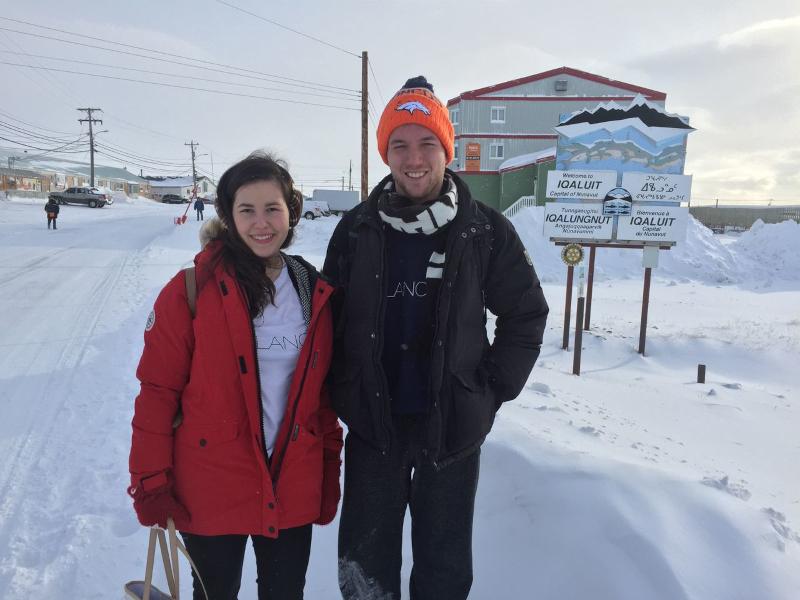
About 10 years ago, Corey Ellis and Alida Burke were in Iqaluit when the harsh conditions prompted the pair to reflect.
“We were working in the Arctic during university, and saw the very high price of food, the very low quality of food and we just felt we could bring our business backgrounds and maybe help bring a solution forward that could address this localized problem in this one community,” Ellis, the cofounder and chief executive officer of Growcer told FoodNX in an interview.
Burke is also cofounder, and the company's chief financial officer.
“It started really small: ‘Let’s just do one farm,’ the one summer, help it get set up and then, lo and behold, 10 years later we’re still doing it,” Ellis continued.
What the pair had come up with was a greenhouse — initially constructed from a shipping container — that could survive and thrive, even in harsh Arctic conditions. Today, Growcer's farms are producing food around the world.
“We’ve worked in over 1,000 communities in 40 countries,” Ellis said.
Recognition as top Canadian ground breaker
People are noticing. Growcer was recently awarded a Governor General’s Innovation Award, one of five such winners.
“This is a really good opportunity for our team to get recognition; the individual team members to have their work validated," Ellis said. "And then to shine a light on what is a national problem but also a national opportunity: the food security space deserves more attention.”
For Growcer, it’s just the latest proof the company is on the right track toward not only building a business but solving one of the major problems facing remote communities in Canada and around the world.
“It’s definitely grown bigger than the original ambition. We did not think we’d be doing this for more than a decade when we first started but as we got more into it, we kept getting more market pull until we realized relatively quickly, this is something that there was a lot of demand for and we felt we were solving a real problem.”
“So that’s why we’ve stuck at it so long.”
How to grow fresh produce in the Arctic
The company ships pre-fab units, for $249,000 as a one-time purchase, or through its “farm-as-a-service option through Growcer Fund” for $4,000 per month, according to its website.
A single unit takes about 15 weeks to install, with one week of training, and a first harvest can happen in four to six weeks after installation.
But for most in the Canada’s north, installation comes with hurdles.
“The challenge is just the austere climate, the relatively low infrastructure from a power and land standpoint. We were trying to create something that was very turnkey, plug and play, that we could build at scale in almost like a factory setting,” Ellis said.
The hydroponic farms can grow lettuce, leafy greens, herbs, brassicas (cabbage and mustard family), and some “cultural crops” regardless of outside conditions. “It’s like a green oasis in the middle of the winter,” he said.
Using Canadian content for construction
While in the early days, Growcer deployed re-purposed shipping containers, today the units are much more attuned to the harsh climate and incorporate 85- to 90-per-cent Canadian content, according to Ellis.
“The building is built out of structural insulated panel. It’s Canadian steel and aluminum sandwiched with foam in between. So think of it like a fully insulated building with no natural light coming.”
“It can withstand colder than minus-40,” he said.
Heating initially comes from LED lighting until the temperature reaches minus-20 or -25. “Just the slight amount of temperature heat off the lights themselves will heat the building, and then it’s well insulated, it’s about R30. It will hold its heat very well.”
But once it reaches that low, “we have a small electric heater, and it kicks on, five minutes at a time, here and there, or when it’s colder than minus 25: it’s just a relatively small size electric heater,” Ellis said.
Who is the target market?
Growcer is headquartered in Ottawa and has a team of 35 spread across Canada and the U.S. Its manufacturing facility is in Winkler, Man., a central location from which to ship product, he said.
Most customers for this technology are “frontline community organizations” such as schools, food banks, homeless shelters or hospitals. “All sorts of organizations that are serving their community and want to improve the food quality, the food security of their community,” Ellis said.
The company has also provided farms for 65 First Nations, Inuit and Metis communities. Growcer also counts institutional and commercial food services as customers, such as mining camps or grocery stores.
It also offers food storage systems, walk-in freezers and fridges, as well as food processing operations for “turning tomatoes into tomato sauce, that kind of thing,” he said.
Helping hand to food banks
Growcer is not only a commercial operation, it is participating in a $15-million fundraising campaign to help fund 100 food banks.
“We’re organizing a philanthropic campaign with some major donors to help these food banks get the capital to make this investment. We have a group of 100 charities in Canada that are at the 80 per cent mark of what they need in funding to get their own grocery farm.”
“They’ve already raised most of the money they need, but we’re just coming in with the last little bit to get them across the line,” he said.


 Industry Events
 Locations