Locations








In order to compete with the two established, long-term sugar refiners in Canada, a relative newcomer to the market has invested $135 million on a new facility in Hamilton.
“We were supplying some of the major multinational food manufacturers but clearly there was a need for more capacity in the market, coupled with the fact that our two major competitors, their facilities are very, very old,” Eli Cohen, vice-president sales operations Canada for Sucro Can Canada, told FoodNX in an interview.
“I think the youngest one is about 80 years old, and then the other one’s well over 100 years old, so for us it’s an opportunity to build something new, more efficient, and bring more than ample capacity to the marketplace.”
Massive size of new building
With the new operation being opened, it will propel Sucro Can Canada (SUGR-X) to become “a major player in the market,” according to Cohen.
“We have significant space going from 60,000 square feet to 14 acres, that’ll expand to 20 acres next year. It just gives us the ability to do things we can’t do today.”
In addition to the larger footprint, the company now has a new raw sugar warehouse that will enable it to store up to 40,000 tonnes, which it didn’t have previously.
“One of the biggest advantages is our previous site, we didn’t have space even to discharge raw sugar or store enough raw sugar, so we had to have a third-party discharge the sugar for us to store the raw sugar, and then truck it to our facility, which is not very efficient and very costly,” Cohen said.
Overall, the facility is expected to refine as much as one million tonnes per year once full capacity is reached, according to the company.
Construction began in April 2024 and was completed in April of this year.
After it opened its Chicago facility, Sucro Can Canada “learned a lesson early on that we’ve never built it as big as we should have built it, and so the idea was, let’s build it for our future needs, not just for the needs we see in the next five to 10 years, so it’s much cheaper to build it bigger now than to try to retrofit something, get equipment in,” Cohen said.
Parent company Sucro opened a Hamilton refinery in 2019 at another location, and the firm was started in Coral Gables, Fla. in 2014. It reported US$149.2 million on sugar deliveries of 179,764 metric tonnes in its Q1 financial results. In 2025, it brought in US$668.9 million in revenue and posted a net income of US$41 million.
History of sugar refining in Canada
The industry processes 1.4 million tonnes of refined sugar annually, worth $1.75 billion in 2023, according to the Canadian Sugar Institute.
The sugar business in Canada has been dominated by Lantic, a Canadian-owned company and subsidiary of Rogers Sugar. It has operated since the 1800s. Redpath Sugar is a Canadian company and subsidiary of the ASR Group, a privately held U.S. company. Redpath has been in business since 1854.
Over 90 per cent of Canada’s refined sugar or sucrose is produced from raw cane sugar, imported mainly from South and Central America. Sucro Can Canada uses non-GMO cane, according to Cohen and imports from Brazil, Argentina and Mexico into the Port of Hamilton.
Ontario is home to one of North America’s largest food and beverage manufacturing clusters, according to the port.
Good time for expansion
Despite challenging conditions economically, the sugar business is well-positioned for expansion, Cohen said.
“The reality is, even in difficult times with the economy, food typically is one area that doesn’t suffer at the same level that others do. Obviously, the average person is not necessarily consuming more sugar but for a lot of the food manufacturers, it’s still hugely beneficial to manufacture finished goods here in Canada and export to the U.S.”
The product is mainly sold to the food manufacturers, he said with only about 15 per cent purchased by individual consumers in grocery stores.
But just like in many other industries, the soaring price of fuel is affecting production.
“Some of the biggest challenges is you have the energy costs. We’re seeing some challenges there because you need a lot of steam to produce sugar, so just managing those challenges; the volatility in that market,” he said.
The plant currently employs 65 persons but the new capacity will be reflected in more hires.
“It’ll gradually go up (and) it’s hard to say exactly the timeline but as we bring on some packaging and everything else, we expect it to grow, whether it’s 10 to 15 next year, more next year, and then going from there, as we’ll also be offloading our own vessels,” Cohen said.
Benefits of deep port
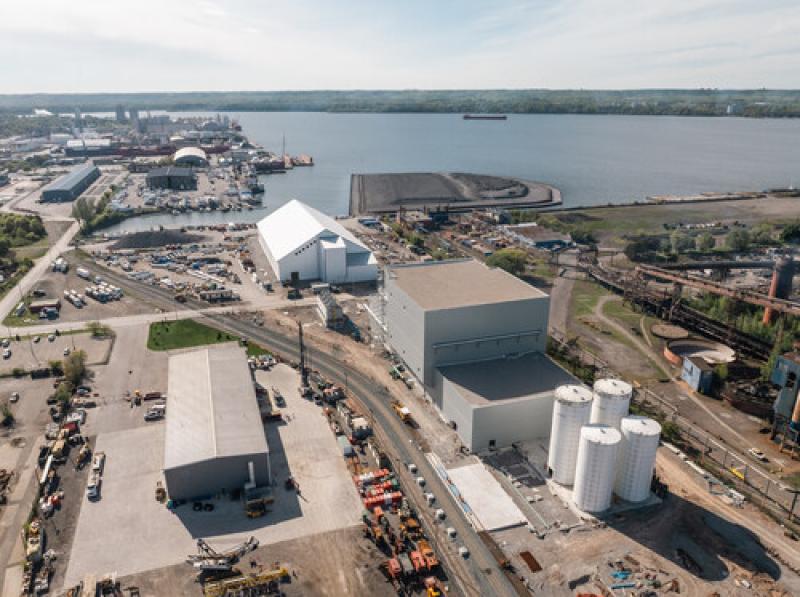
Choosing Hamilton as a location was helped by its “ideal location,” Cohen explained as it facilitates delivery to Ontario, Quebec and the U.S. northeast.
“When it came down to it, the Hamilton area was the perfect location, and the port was a perfect partner, and they’ve been with us since the beginning. They like to drive vessel traffic and imports coming through the (St. Lawrence) seaway. So, it works well for both parties.”
The Hamilton location also offers full rail access.
With its new expanded refinery, Sucro Can Canada has some lofty goals for the future. “We know it’s not going to happen overnight, and we know it may take many, many years, but ideally we want to be the number one supplier in Canada, now that might be 20 years from now.”





 Industry Events
 Locations