Locations







Canada’s food wastage problem is enormous. According to a recent study, it accounts for $58 billion in spoiled food each year that is discarded.
McMaster University researchers are working on mitigating this by developing technology that can accurately assess the freshness of food, so it can be diverted before it goes bad.
“What we are trying to do is to reduce this spoil stage by early predicting the freshness score, which is not developed yet; it’s just in the initial stage,” Md. Masuduzzaman, a postdoctoral fellow at the DeGroote School of Business in McMaster University, told FoodNX in an interview.
Masuduzzaman and Elkafi Hassini, professor of operations management at the DeGroote School of Business, are working on a “framework” named FreshTrack to help those who produce, store and deliver perishable food better recognize when it will spoil.
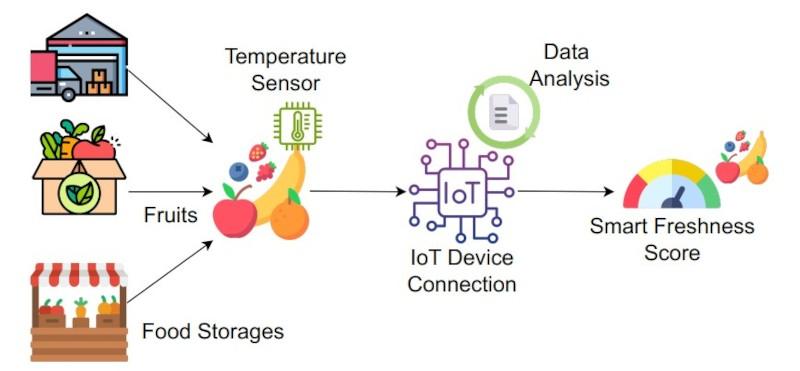
“What we are trying to do is utilizing some sort of sensors, so that we can get the temperature, humidity, so we can collect the data from those perishable food items and put it in our model,” Masuduzzaman said.
Instant feedback on food quality
Once a system is developed, they are hoping to use IoT (Internet of Things) sensors so that producers and others can get instant feedback on the quality of the food, he said.
“Then the model will estimate some sort of value, let’s say from one to 100, and based on the score, we will classify those perishable food items into excellent, good, average, below average, and bad, something like this.”
It will automatically trigger an alert that something is wrong with the quality of the perishable items.
The system would also work with blockchain technology, which assures its security and “immutability,” according to a study co-authored by Masuduzzaman.
If they succeed, FreshTrack should provide more accurate data, than does the current best-before system currently deployed, which does not provide an accurate picture of food quality.
“This (best-before) date is basically estimated in a control chamber where the temperature is fixed but whenever you transfer those perishable food items from, store to some other store, or from farm to fridge, the temperature will vary: it’s not consistent all the times,” Masuduzzaman said.
According to research done by Second Harvest, misuse of best-before dates accounts for 23 per cent of avoidable food waste, worth $12.4 billion each year.
Hassini and Masuduzzaman are also working on a way to augment that data by monitoring how the food looks to further assess its quality.
By studying the outside of fruit, such as bananas or apples, a more accurate spoilage picture could be determined, according to Masuduzzaman.
“We are trying to classify the images as well but that is not published yet. We are doing experiments, and we are trying to develop some more accurate score based on the image as well,” he said.
Pilot project to save food
While work continues on creating the best possible sensor system, Masuduzzaman and Hassini are already working on a way to divert food to food banks. The team have launched a pilot program in Hamilton that has already served 35 families, Masuduzzaman said.
The team is working with community agency Mishka Social Service and Middle Eastern and South Asian grocery store Eastern Food Market on a digital platform called CrowdFeeding. It recently completed a six-week test in which recipients received food baskets directly to their homes.
“They have just to order online because we created one website for them, and then they have ordered through the website, and we try to deliver that food to the people who are already registered in the food bank,” explained Masuduzzaman.
Organizations and individuals can also download an app and register to receive food donations or donate expiring food.
“It is a platform for reimagining food redistribution systems at the intersection of operations management, digital innovation, and community engagement,” according to the LinkedIn page detailing the pilot project.
Efforts to eliminate unused food
This all fits into the team’s goal to reduce food waste by demonstrating ways it can be accomplished.
“If we can develop a system where retailer, shopkeepers and everyone can utilize our system to get the freshness score, and they can donate the food before spoilage, it will be social work," Masuduzzaman said.
"So, before the spoilage stage, if they can donate this food to the food banks, the food banks can easily deliver those foods to the people who have already been registered."
The team is working on how to solve this problem outside of Canada.
“We are already working with our collaborators in the U.K., Sweden, Finland, Singapore and Rwanda. So, we are trying to make a project proposal where these six countries can work together and try to see that how this food bank (system) is working.”
By discovering how other countries deal with food waste, they could share information and roll out a greater solution, Masuduzzaman said.
“We need to collaborate with one another, and then we need to find out a unique idea how we can implement our idea in each of those countries. If we are successful doing those things, then in future, we can spread this idea all over.”
“This project is ongoing, and a lot of people are really interested to see that can be implemented in real life," Masuduzzaman said. "We can expect that within next year we will try to develop a full model where the Canadian people and the Canadian society will benefit from our work,” he said.


 Industry Events
 Locations